|
Whiskey
Hill or Woodside?
Although the name "Whiskey Hill" occasionally appeared
in the Northern Mines, the only surviving town named Whiskey
Hill (now renamed Woodside) is located in San Mateo County.
By the late 1800s there wore fifteen sawmills within five
miles of "Tripp's Woodside Store" and over one thousand
lumberjacks received their dentistry, mail, supplies, and
whiskey from Doc Tripp until he died, in 1909. Today, the
store, at the corner of Kings Mountain and Tripp Roads,
belongs to the San Mateo County Parks and Recreation Division.
With the growth of the San Mateo County wood-related industry,
serving San Francisco and Alviso via barges and ships from the
Redwood (City) Embarcadero and other locations via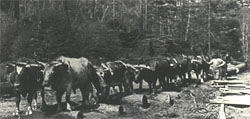 teamsters,
the commercial center moved from the Tripp Woodside Store to
about one and one-half miles east (toward San Francisco Bay)
to the area called Whiskey Hill. It got that name because of
the three saloons and two hotels, one run by Peter Hanson.
Those enterprises, plus a blacksmith shop, had been created to
supply the demand at that busy crossroads. teamsters,
the commercial center moved from the Tripp Woodside Store to
about one and one-half miles east (toward San Francisco Bay)
to the area called Whiskey Hill. It got that name because of
the three saloons and two hotels, one run by Peter Hanson.
Those enterprises, plus a blacksmith shop, had been created to
supply the demand at that busy crossroads.
...as teamsters drove wheeled wagon-loads of
milled lumber from those local San Mateo County mills to the
Redwood (City) Embarcadero, they regularly stopped at Whiskey
Hill (after a haul of from two to four miles) to fortify
themselves for the downhill pull (of six or seven miles) into
the Redwood Embarcadero or south, toward Santa Clara and San
Jose.
Today, Whiskey Hill is lively and thriving, with the
Pioneer Saloon
still vending and pouting spirituous elixir. The Woodside Town
Center, including Independence Hall (1886), and many other
businesses flourish at that historic intersection, which is
today part of "Downtown Woodside."
The lumber camp and town of Searsville is marked by SRL No.
474, located at the intersection of Portola and Sand Hill
Roads, near the western terminus of the Stanford Linear
Accelerator. John Sears settled there in 1854, and the camp
grew into a town with a hotel, school, store, blacksmith, and
both tent and wooden dwellings. The town was dismantled in
1891 to make way for the rising, dammed waters of Searsville
Lake on Stanford lands. Sears also pioneered the first road
(Old La Honda Road) over the Santa Cruz Range and founded the
town of La Honda in 1861.
Finally, history-loving locals from southern San Mateo County
and Palo Alto/Stanford still say "Whiskey Gulch" when they
refer to the commercial area of University Avenue, north,
across San Francisquito Creek in San Mateo county. The area
got its name about 1900, when Jane Lathrop Stanford's will
demanded that "no alcohol" be served within one mile of the
Stanford Campus. Her will, however, was filed in Santa Clara
County and did not hold sway in San Mateo County. Bars,
saloons, and liquor stores flourish there to this day even
though the anti-liquor provision of Jane Stanford's will was
overturned in the 1970s. Hail progress!
DEKE SONNICHSEN
Renaissance man DEKE SONNICHSEN is a world-renowned balloonist
and pilot examiner, anvil-firer, X Noble Grand Humbug of Yerba
Buena #1 E Clampsus Vitus, and chair of the board that advises
the San Mateo County Board of Supervisors on historic
resources.
From: http://www.paulrich.net/students/readings/california_gold_rush/california_gold_05.html |